Connected TV (CTV) sits at an interesting intersection for performance marketers. It offers the visual impact of television with the promise of digital-style targeting and reporting, all delivered on the biggest screen in the house. It’s no surprise that budgets keep shifting in its direction.
Yet for all that momentum, CTV still makes many teams uneasy. Results often look strong in platform dashboards, but confidence erodes when those numbers are compared with internal analytics or marketing mix models. Over time, CTV quietly slides into the brand budget because its impact can be difficult to explain.
When that happens, the root cause often comes down to the data foundation underneath the targeting and measurement, and how well it reflects real households and real buying behavior.
The good news is that this isn’t an inherent limitation of the channel itself. When CTV is built on a data foundation designed for accountability, it can support the same performance expectations marketers apply elsewhere. For brands willing to treat CTV as a measurable growth channel rather than a branding experiment, the opportunity looks very different.
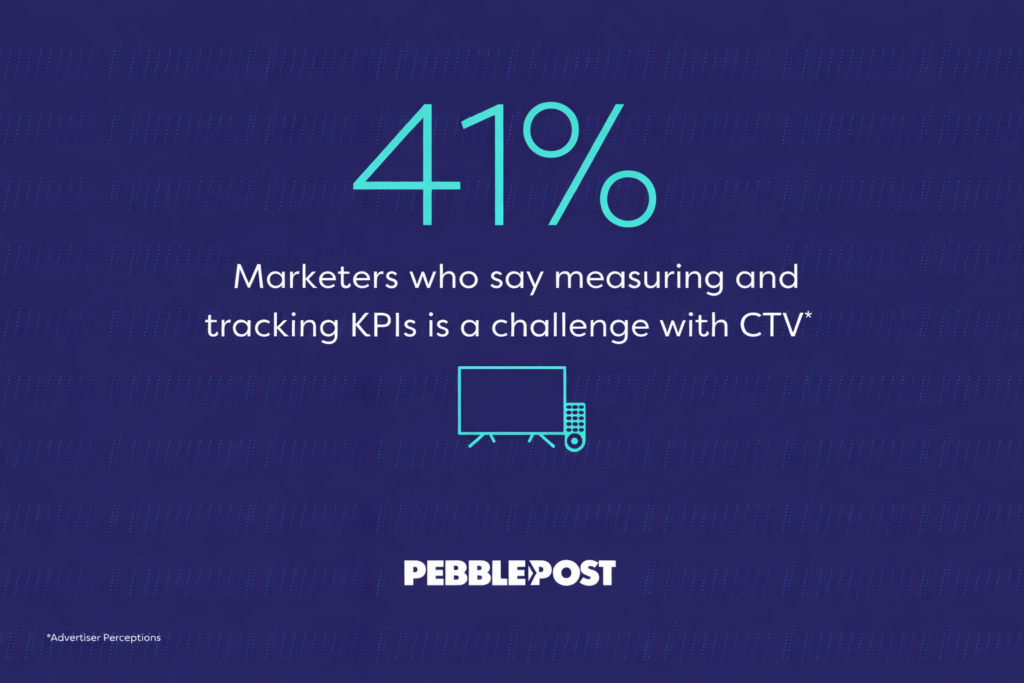
Where CTV Performance Starts to Drift
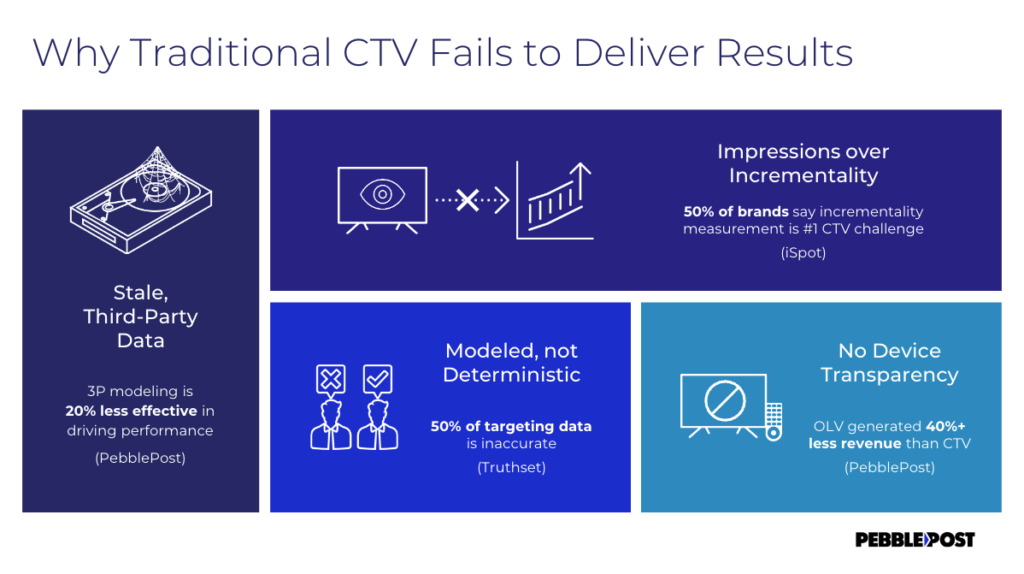
Most CTV ad targeting today depends on a familiar set of inputs. Platforms offer access to broad third-party audience segments built from modeled data, combined with identity systems that attempt to infer households by stitching together devices and cookies. These approaches were designed to maximize reach and scale, not to support transaction-level accountability.
That distinction matters, especially in a performance environment where marketers are expected to show results quickly and adjust just as fast.
Third-party audience data often refreshes slowly, which means targeting decisions are based on past behavior rather than current intent. When teams are under pressure to drive near-term outcomes, stale signals make it harder to respond to what’s actually happening in market.
Identity resolution built on probability can be directionally useful, but it becomes far less reliable once marketers try to answer questions about incrementality, net-new customers, or true return on spend.
As long as CTV relies on these assumptions, performance reporting will remain disconnected from how the business actually measures success.
Why Household-Level Thinking Matters in CTV
CTV lives in a shared space. Entire households watch it, and the purchases it influences (travel, retail, home, subscriptions, etc.) are often made collectively. Treating CTV as a device-level or person-level channel introduces friction between how ads are delivered and how decisions are made.
A household-level approach realigns those two realities.
Instead of starting with devices and inferring who might belong together, household-based targeting begins with a known household anchored to a physical address. From there, identifiers such as email addresses, phone numbers, and IP addresses can be resolved back to that household, creating a more stable and realistic view of who is being reached.
This underlying structure is often called an identity graph. The terminology isn’t the important part. What matters is whether the data can reliably connect ad exposure to real households and, ultimately, to real purchases.
The Role of Transaction Data
Household identity becomes far more valuable when it’s informed by verified transaction data. Purchase behavior provides a level of signal that browsing activity or inferred interest simply can’t match.
When transaction data is part of the picture, CTV targeting changes in meaningful ways. Audience strategy shifts away from broad demographic assumptions and toward patterns drawn from actual customers. Lookalike models can be seeded with high-value buyers instead of generic segments. Retargeting becomes more selective, focusing on households with a demonstrated likelihood to convert rather than everyone who happened to visit a site.
This approach prioritizes relevance over volume, focusing spending on households with the strongest signals of intent. Fewer impressions are wasted, and performance becomes easier to sustain over time.
Measurement That Reflects Reality
Measurement challenges in CTV stem from uncertainty about who was exposed and what happened next.
When targeting and measurement share a household-level foundation, that uncertainty starts to fade. Exposure can be tracked at the household level, transactions can be matched back across channels and points of sale, and outcomes can be compared between exposed and unexposed groups that look similar before the campaign ever runs.
This makes incrementality testing practical rather than theoretical. Holdout households can be established with confidence, and lift can be measured based on observed behavior instead of modeled attribution. Over time, this allows brands to optimize CTV around incremental ROAS, CAC, and conversion lift rather than proxy metrics that only tell part of the story.

What This Looks Like in Practice
Brands that move CTV onto a household-first data foundation tend to see a few consistent shifts.
Targeting becomes more disciplined. Instead of buying reach for its own sake, teams focus on households that resemble their best customers across categories and channels.
Measurement aligns more closely with internal reporting. CTV performance is easier to reconcile with analytics and finance because it’s tied to verified transactions and clear control groups.
Budget conversations become more productive. When results can be explained in business terms, CTV earns its place alongside other performance channels rather than being treated as a necessary but opaque investment.
None of this requires changing the creative format or the inventory being purchased. The difference comes from the data supporting the decisions.
What Ultimately Determines CTV Performance
CTV struggles as a performance channel when targeting and measurement rely on inferred identity and third-party data that were never built to support transaction-level accountability.
When CTV is planned and measured around real households and real purchase behavior, its role changes. Performance becomes more predictable, measurement becomes more credible, and CTV starts to function like a repeatable growth lever.
For brands looking to get more out of CTV, the most meaningful upgrade is the data foundation underneath the entire strategy. Because CTV ad performance depends on how clearly you understand who’s watching and what they do next.
Looking to drive measurable CTV impact? Reach out to learn how PebblePost Performance CTV cuts through the noise with precision targeting to deliver incremental outcomes you can actually prove.